Document Records - Vintage Blues and Jazz

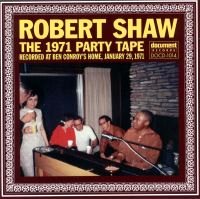
Robert Shaw The 1971 Party Tape

£7.49   


FEATURED ARTIST / S
Robert Shaw

    TRACK LIST
01 - Piggly wiggly
02 - 11:30 Saturday night
03 - Black gal
04 - Jump steady blues
05 - Hattie Green #1
06 - Throw me in the alley Listen
07 - Jim nappy
08 - Don`t cry
09 - Melody in e flat
10 - Woman, oh woman
11 - Wood in my woodhouse
12 - Instrumental in G
13 - Dirty duckins #1
14 - Pine Top`s boogie woogie
15 - Saturday night special
16 - The Clinton
17 - The girl I used to love
18 - Whores is funky Listen
19 - Hattie Green #2
20 - Four o`clock blues
21 - She used to be my baby Listen
22 - People, people Listen
23 - Dirty duckins #2
24 - Woke up early this morning

Robert Shaw CDs When interviewed years later, Robert told an interviewer how he would "crawl under the house" to catch the musical strains coming from one of his sisters' piano lessons. Robert would play the piano in secret when the family were away from home and practised the songs that he heard when running errands in town. The first song that he reportedly learned was "Aggravatin' Papa Don't You Try To Two-Time Me".
By the time he was a teenager, Robert Shaw would slip away from the farm to hear Jazz musicians play in the clubs and roadhouses in and around Houston. As soon as he was able Robert sought out a piano teacher and payed for the lessons out of his own earnings.
In time, despite his father's continuing opposition, he decided to pursue his dream of becomming a Jazz musician.
The ragtime elements and the "barrelhouse" piano style that he learn't at this time were to influence his playing throughout his life. The barrelhouse piano style that Shaw played employs a heavy, hard-hitting contact coupled with a fast release. The name of this style came from the barrelhouses, where it was performed in sheds lined with beer and whisky, an open floor and a piano on an elevated platform in the corner of the room. Shaw learn't this unique style of playing from other Jazz Musicians in the Fourth Ward, Houston, which was the cetre of black entertainment in the city. These were the very same clubs that put on blues artists such as Sam (Lightnin') Hopkins. In the 20's Shaw became part of an itinerant band referred to as the "Santa Fe Circuit" because the musicians used Santa Fe freight trains to enable them to tour. These tours would take Shaw as far north as Chicago, but he mostly confined himself to venues in Texas. As well as playing with the band he also appeared as a soloist in the clubs and roadhouses in towns such as Sugar Land, Richmond, Kingsville and the big cities of Dallas and Houston. When there was an oil boom in Kilgore in the 30's Shaw went there to play and in 1932 he went to play in the Black Orange Cafe in Kansas city. In 1933 he had a radio show in Oklahoma City before deciding to return to Texas where he eventually opened a grocery store called the Stop and Swat, in the mostly black east side of town.
In 1939 he married Martha Landrum, in Austin, Texas. Shaw continued to work his grocery business for the next few decades, playing very few public performances. In 1962 he was named black business man of the year but also continued to play his music privately and for people who would drop by the Stop and Swat. With the arrival of 1967, Shaw returned to the gig circuit, this time being appreciated by a younger audience and growing fame. This new found enjoyment of his performances would lead Shaw to play not only in festivals in the States but also touring European countries such as Holland and Germany. In addition to this he also played at the World's Fair Expo in Canada, various folk festivals and the New Orleans Jazz and Heritage Festival. Shaw also made at least one album at this time, called Texas Barrelhouse Piano.
This disc was recorded in Austin by Mack McCormick and released through his own Almanac Book and Recording Company, later to be re-issued by Arhoolie Records.
The Robert Shaw recordings on this Document Records CD features a selection of the McCormick recordings, live concert recordings, radio sessions and the recording by Ben Conroy, on a reel-to-reel recorder at a house party of his making, in 1971. The party went on for at least 4 hours, capturing a whole evening with Robert Shaw, his music and many personal recollections of his earlier performing years.
Throughout the 70's and early 80's Shaw continued to play and tour, which led to an invitation to play in the Texas Commission on the Arts program between 1981 and 1983. Robert Shaw died of a heart attack on May 16th, 1986, in Austin.
Shaw's musical output remained fresh throughout his career, practising and developing his unique barrelhouse piano style which was unaffected by newer or more popular blues styles and it was his commitment to this black musical technique that ensured it's survival.

This CD includes a 22 page booklet, an article by Ben Conroy, a list of all Robert Shaws recordings and what key they are played in by Konrad Nowakowski, a list of all unissued recordings by Robert Shaw by Konrad Nowakowski, photographs, musician personnel, and original discographical details.
Home SearchSpecials Services MP3'sArchive News Contact View Cart
ÿ